

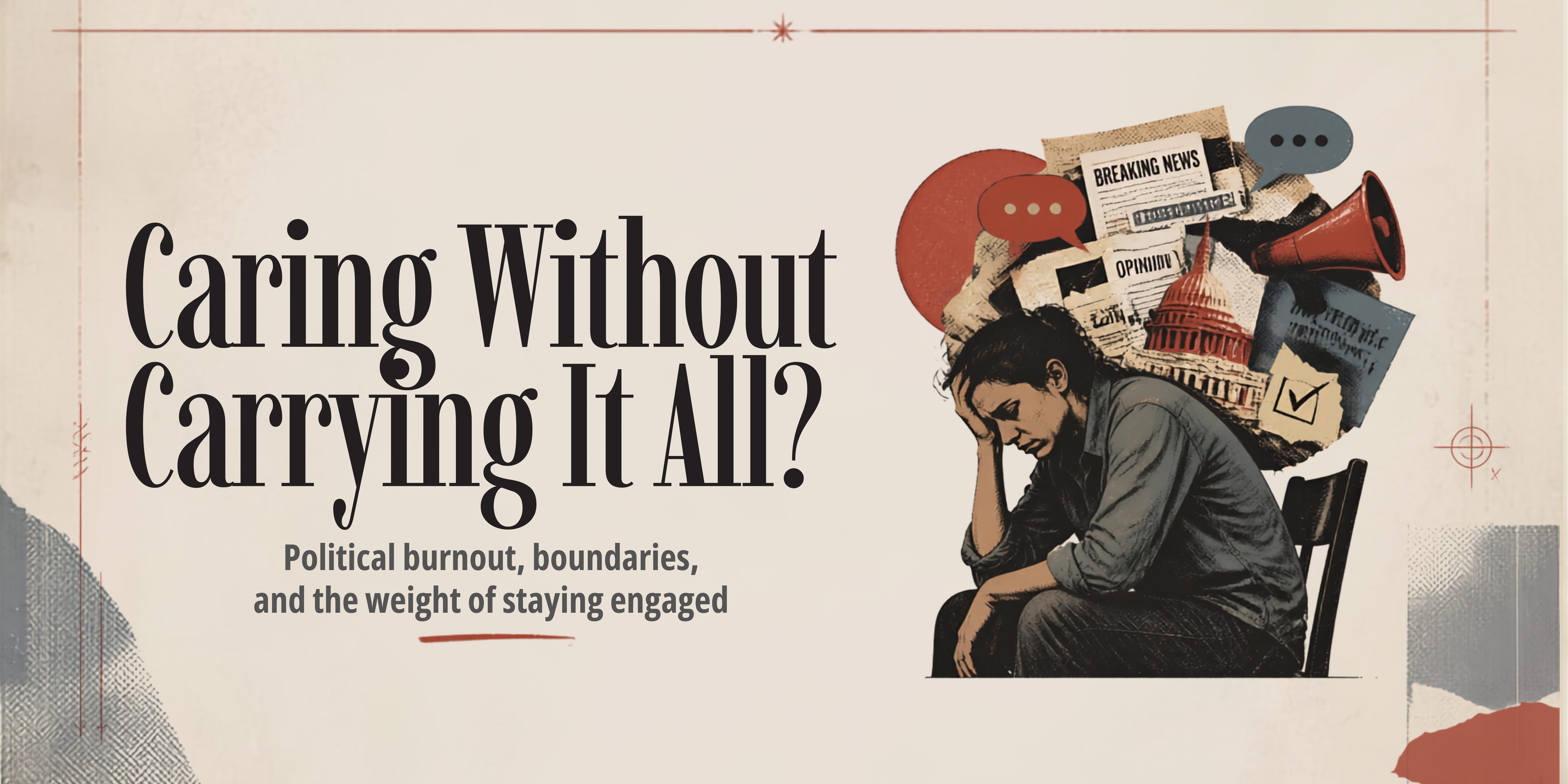
Here’s something we’ve been sitting with for a while, and we’re finally ready to say it out loud: the thing burning you out might not be the news. It might be how you’re being told to consume it. (More on that in a second; it changes how we think about all of this.)
If you feel like you can’t keep up with the news without your nervous system paying the price, you aren’t imagining it. We’ve felt it too.
Political engagement has quietly become another always-on subscription: infinite scroll, infinite alerts, infinite pressure to have a take on everything, all the time. Nobody designed it this way on purpose. But the lived experience is real: staying informed now costs something closer to your mental health than your morning coffee.
The data is starting to reflect that pressure. Recent surveys put Gen Z at the top of the burnout rankings across generations, and unlike past cohorts, that exhaustion is showing up early, hitting people in their mid-twenties instead of their forties. Politics isn’t the only driver, but it’s a significant one: in one national poll, it ranked just behind financial stress as a top source of anxiety for young people.
You’re Not Imagining It
The dominant narrative says our generation is apathetic. The numbers suggest something else: we’re navigating an information environment that’s become harder to regulate and easier to drown in.
The Volume Problem: Recent campus reporting describes Gen Z’s political disengagement less as ignorance and more as a protective response to nonstop political messaging and social pressure to perform a position on everything, publicly, at all times.
The Two Exhausted Extremes: Some young people organized, marched, and posted constantly and watched intensity fail to translate into outcomes, until conviction curdled into frustration. Others went quiet altogether, not out of apathy, but self-preservation, in a climate where disagreement is often treated as a personal failing rather than a difference of opinion.
The Quiet Opt-Out: Nearly half of young people surveyed recently said they now actively avoid political content on social media altogether, a near-even split across party lines, suggesting this isn’t ideological. It’s exhausting.
Turning Exhaustion Into Sustainability
If the system is asking for constant vigilance, the response can’t just be “try to care less.” It has to be a better design for how you engage, not whether you do.
Builders and organizers across youth civic spaces are having similar conversations about pacing, not lowering the stakes of what’s at risk, but acknowledging that a generation running on empty can’t show up when it matters most.
TOGETHER! Tool Kit (What To Do This Week)
Small, doable, no guilt attached:
Set a real off-ramp. Block one specific window, an evening, a Sunday morning, whatever, where you’re fully offline from political content. Put it on your calendar like it’s a meeting, because it is.
Mute before you spiral, not after. Go mute or unfollow one account that consistently leaves you wired and anxious instead of informed. You can always come back.
Talk to one person, not the timeline. Instead of posting a take, have one real conversation about something you care about. It’ll probably feel more useful anyway.
What Is Next?
Question: What’s one part of your political engagement that’s actually draining you, and what would it look like to let that one thing go?
Explore: Become a TOGETHER! to connect with organizers who are building civic spaces that don’t require burning out to belong.
If this hit close to home, don’t keep it to yourself; send it to the friend who’s been doom-scrolling since 2020. They’ll thank you later. And subscribe so you don’t miss what’s next; this is only the first piece of it.
— The TOGETHER! Team
P.S. For our readers in D.C., we’re publishing a biweekly TOGETHER! DC edition focused on the crossroads of policy, culture, and youth power. Get the latest on upcoming events, local collaborations, and spotlights on young changemakers in the District.
Subscribe here: https://togetherdc.substack.com/